
Maricopa County Superior Court Felony Case Process

How a felony case moves through the Maricopa County Superior Court, from charge to sentencing.
Recognized By






As Seen On

Recognized By

From Arrest To Appeal In Maricopa County Superior Court
Felony charges in Maricopa County move quickly. Hearings, deadlines, and paperwork start almost immediately after an arrest. For many people, the process feels confusing and rushed.
This guide walks through each major step of a Maricopa County Superior Court felony case so you and your family know what is happening and why it matters.

Table Of Contents
Use this guide to follow the Maricopa County Superior Court felony case process from the first court appearance through possible appeals.
- How the Maricopa County felony process is structured
- Step 1: Initial Appearance
- Step 2: Probable cause through preliminary hearing or grand jury
- Step 3: Arraignment
- Step 4: Initial Pretrial Conference
- Step 5: Comprehensive Pretrial Conference
- Step 6: Settlement conferences
- Step 7: Final Trial Management Conference
- Step 8: Trial
- Step 9: Plea agreements
- Step 10: Sentencing
- Step 11: Appeals and post conviction relief
- How you can support your felony defense
- Frequently asked questions
- Talk with a Maricopa County felony defense lawyer
How The Maricopa County Felony Process Is Structured
Most felony cases in Maricopa County follow a basic structure. There is an arrest, an Initial Appearance, a probable cause determination, arraignment, several pretrial conferences, and either a plea or a trial followed by sentencing. Some cases continue to appeal or post conviction review.
Not every case uses every possible hearing. The steps below describe the most common path so you can see the big picture instead of viewing each court date in isolation.
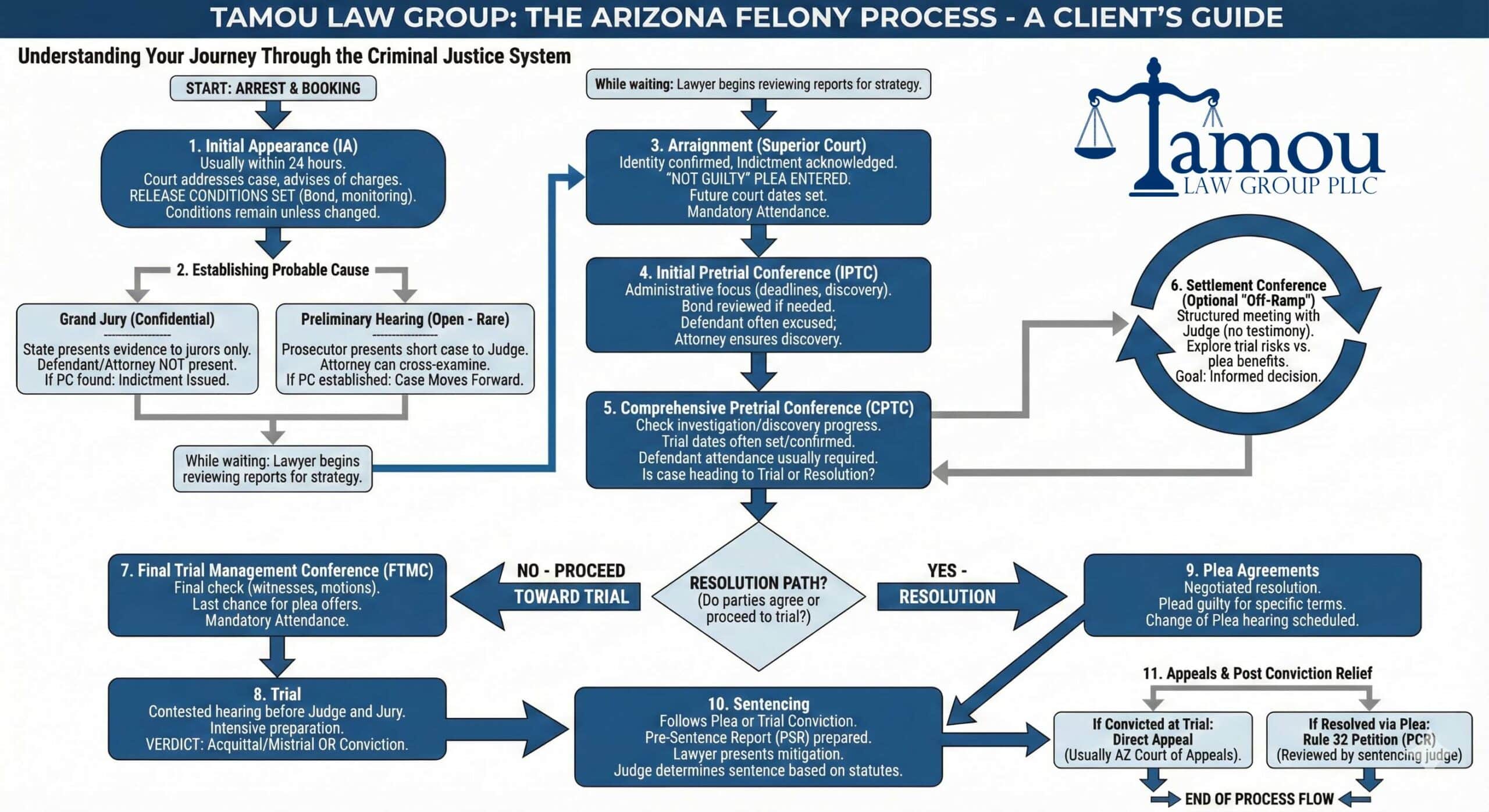
Step By Step: Maricopa County Superior Court Felony Case Process
The cards below explain what happens at each stage, where it usually takes place, and how a defense lawyer uses that step to protect you.
Initial Appearance (IA)
After a felony arrest, Maricopa County must bring you before a judicial officer within about 24 hours. This is the first time the court formally addresses your case.
- You are advised of the allegations and potential classification of the offense.
- The court sets release conditions such as bond, third party supervision, or pretrial services.
- These conditions can include electronic monitoring, curfew, and restrictions on travel outside Arizona.
The release conditions set at your Initial Appearance usually remain in place unless a judge later agrees to change them. Violations can lead to arrest or stricter conditions.
Probable Cause: Preliminary Hearing Or Grand Jury
A felony case cannot continue in Superior Court unless the State first shows there is probable cause that a crime occurred and that you may be responsible. This can happen in one of two ways.
Preliminary Hearing
In a Preliminary Hearing, the prosecutor presents a very short version of their case to a Judge. You and your attorney get to attend, and your attorney gets to cross-examine whichever witnesses the prosecutor has testify. The Judge then decides whether the prosecutor has established probable cause. Preliminary Hearings do not happen very often within the Maricopa County Superior Court.
Grand Jury
In many cases, the State presents evidence to a Grand Jury instead of holding a preliminary hearing. The proceeding is confidential. The defendant and defense lawyer are not in the room and are unaware of the proceedings. If the jurors find probable cause, they sign an indictment that becomes the formal charging document.
If the Grand Jury returns an indictment before a planned preliminary hearing, that earlier hearing is usually vacated. Once the indictment is filed, the court schedules an arraignment and sends notice to defendants who are out of custody.
While waiting for arraignment, your lawyer begins reviewing reports, any Grand Jury transcript, and other early disclosure so strategy can start to take shape.
Arraignment
Arraignment usually happens at the Maricopa County Superior Court South Court Tower in Phoenix. This hearing is short but important.
- The court confirms your identity on the record.
- The indictment or information is acknowledged.
- A plea of not guilty is entered in almost every case.
- The judge sets the first round of future court dates.
Even though the hearing is brief, attendance is mandatory. Missing arraignment can result in a bench warrant and added complications.
Initial Pretrial Conference (IPTC)
Shortly after arraignment, the court holds an Initial Pretrial Conference. This hearing focuses on administration, not testimony.
- The judge confirms that you have a lawyer of record.
- Discovery timelines and disclosure obligations are addressed.
- Bond or release issues may be reviewed if there are problems.
Many IPTC hearings are marked as non appearance for the defendant. Your attorney still appears and uses the hearing to keep the case on track and ensure the State is turning over required discovery.
Comprehensive Pretrial Conference (CPTC)
The CPTC takes place later in the process. By this point, the court expects real progress on discovery, investigation, and negotiations.
- The judge checks on outstanding discovery and motion issues.
- Witness lists and evidence questions may be discussed.
- Trial dates are often set or confirmed at this stage.
Defendants are usually required to attend a CPTC. It is often the point where everyone sees whether the case is likely to resolve by plea or head toward trial.

Settlement Conferences
In many Maricopa County felony cases, your criminal defense attorney may request to schedule a settlement conference. This is a structured meeting where the parties speak with a judge about possible ways to resolve the case without trial.
The settlement conference is usually held in a courtroom or conference room. In some cases, a judge who is not the trial judge conducts the conference. In other cases, the assigned judge may handle it. The prosecutor, defense lawyer, and sometimes a victim advocate or detective are present. The defendant almost always attends, either in person or, in limited situations, by video or phone if the court allows it.
Settlement conferences are different from regular hearings because the focus is on open discussion rather than formal argument. The judge may:
- Ask each side to summarize the case and the main disputed issues.
- Explain how the law, sentencing ranges, and prior convictions could apply at trial.
- Give a neutral view of the strengths and weaknesses on both sides.
- Discuss current plea offers and possible changes to those terms.
No witnesses testify at a settlement conference, and the judge is not deciding guilt or innocence. The goal is to help everyone understand the risks of trial and the benefits and limits of any plea. In many cases, the judge’s feedback helps the defendant decide whether to accept a plea or continue toward trial with a clearer view of the possible outcomes.
Conversations at a settlement conference are generally treated as part of plea discussions. That means the purpose is to encourage honest dialogue about resolution, not to create evidence that will later be used at trial. Settlement Conferences can take place at any time during the case but usually occur near the FTMC or trial.
Final Trial Management Conference (FTMC)
The FTMC is the final scheduled conference before trial. The court uses this hearing to make sure there are no loose ends.
- The judge confirms that discovery is complete or nearly complete.
- Witness and exhibit lists are finalized as required by rule.
- Any remaining motions are addressed or set for argument.
- Jury selection, courtroom logistics, and estimated trial length are reviewed.
Judges often ask whether you understand any plea offers and whether you want to accept or reject them. Attendance is mandatory even if negotiations are ongoing.
Trial
If the case does not resolve by plea, it proceeds to trial. Preparation for trial is intensive and requires close contact with your lawyer.
- You and your attorney meet to discuss strategy and testimony.
- The defense may interview State witnesses and consult experts.
- Pretrial motions are filed to limit or exclude certain evidence.
Staying in contact with your lawyer is critical. New dates, late disclosure, or urgent decisions can arise quickly. If you fail to appear for trial, the court may issue a warrant and allow the case to move forward without you.
Trial can end in acquittal, conviction on some or all counts, or a mistrial if the jury cannot reach a unanimous verdict.
Plea Agreements
Many felony cases resolve through plea agreements. A plea is an agreement where you plead guilty to one or more charges in exchange for specific terms that are usually safer than the risk at trial.
- The prosecutor decides whether to offer a plea and what the terms are.
- You decide whether to accept or reject the offer.
- Your lawyer explains the evidence, the law, and the likely outcomes so you can choose with full information.
If a plea is accepted early enough, your lawyer may be able to schedule a Change of Plea hearing in front of a Commissioner and, in some cases, have input on which judge will handle sentencing. After the plea is entered in court, sentencing is usually set about 30 days later.
Sentencing
Sentencing follows either a plea agreement or a conviction at trial. Before sentencing, the probation department prepares a Pre Sentence Report, often called a PSR.
- You complete forms, answer questions, and attend an interview.
- The report describes the offense, criminal history, and personal background.
- The judge reviews the report and any recommendations when deciding the sentence.
Your lawyer will gather character letters, employment records, treatment documents, and other mitigation to present your full story. Arizona sentencing is controlled by statute. Some offenses carry mandatory prison time or limit probation, especially when there are prior felony convictions.
Appeals And Post Conviction Relief
After sentencing, some defendants have options to challenge their conviction or sentence. The process depends on whether the case went to trial or resolved through a plea.
- If you were convicted at trial, you usually have a right to file a direct appeal to the Arizona Court of Appeals.
- If you entered a plea, your main option is often a Rule 32 Petition for Post Conviction Relief.
A Rule 32 petition is filed in Superior Court and reviewed by the sentencing judge. It can raise issues such as constitutional violations, newly discovered evidence, or ineffective assistance of counsel. If the petition is denied, you can ask the Court of Appeals to review the decision, and that court decides whether to accept the case.
How You Can Support Your Felony Defense
The court process matters, but your day to day choices matter too. The points below summarize how defendants can help their attorneys protect them in Maricopa County felony cases.
Stay In Touch
Communication with your lawyer should be consistent and honest.
- Keep your contact information current.
- Return calls and messages as soon as you can.
- Review discovery and bring questions to your attorney.
Protect Confidentiality
What you say outside your lawyer’s office can become evidence.
- Do not discuss the facts of your case with friends, family, or cellmates.
- Assume jail calls are recorded and can be used in court.
- Save detailed conversations about the case for your attorney only.
Follow Release Conditions
New charges or violations make any case harder to resolve.
- Follow travel rules, no contact orders, and curfews exactly.
- Avoid people or places that put you at risk of violations.
- Ask your lawyer before changing jobs, moving, or traveling if conditions might be affected.
Present Yourself Well
Judges and prosecutors notice how you present in court.
- Dress respectfully for every hearing.
- Be polite to court staff, deputies, and the judge.
- Consider treatment, work, or school that shows positive change.
Work As A Team
You control some decisions. Your lawyer controls legal strategy. Both roles matter.
- You decide whether to accept a plea or go to trial.
- Your lawyer decides which motions to file and how to question witnesses.
- Share concerns early so your attorney can address them before deadlines.
Ask Questions
The felony system is complicated. You are allowed to ask for clarity.
- Ask what each hearing is for and what could happen.
- Request plain language explanations of risks and options.
- Use your lawyer as a guide so you can make informed choices at every step.
Maricopa County Felony Case Process Frequently Asked Questions
These answers address common questions that come up when someone is charged with a felony in Maricopa County Superior Court.
1. How soon will I see a judge after a felony arrest in Maricopa County
Most people appear for an Initial Appearance within about 24 hours of arrest. At that hearing, the court explains the allegations, sets release conditions, and may ask questions about counsel if you cannot afford a lawyer.
2. What is the difference between a preliminary hearing and a grand jury
A preliminary hearing is a short evidentiary hearing in Justice Court where the prosecutor presents live testimony and the judge decides if there is probable cause. A grand jury is a confidential proceeding where jurors review evidence without the defendant or defense lawyer present. Either process can lead to an indictment in Superior Court.
3. Do I have to go to every court hearing
Some early hearings such as certain Initial Pretrial Conferences may be designated as non appearance, so your lawyer can appear without you. Others such as arraignment, Comprehensive Pretrial Conferences, Final Trial Management Conferences, change of plea hearings, and trial usually require your personal appearance. Always follow your lawyer’s instructions about when you must be present.
4. Can a Maricopa County felony case be dismissed or reduced
Some cases can be dismissed or reduced. It depends on the strength of the evidence, any legal problems with the investigation, and the mitigation your lawyer presents. A defense attorney looks for constitutional violations, weak proof, credibility issues, and alternative resolutions that can improve the outcome.
5. How long does a felony case in Maricopa County usually take
Some felony cases resolve in a few months. Others can take a year or longer. The timeline depends on the type of charges, court scheduling, discovery, expert work, and motion practice. Your lawyer can give you a better estimate once they see the evidence and the court calendar.
6. Should I talk to police or the alleged victim about my case
In most situations, you should not talk to law enforcement or the alleged victim without first speaking to your lawyer. Statements that feel helpful in the moment can be used as evidence later. Contact with a victim or witness can also violate release conditions. Always run questions through your attorney first.
7. What happens if I take a plea or if I am found guilty at trial
After a plea or conviction, the court sets a sentencing date. A probation officer prepares a Pre Sentence Report, and both sides present arguments and mitigation. The judge then imposes a sentence within the ranges allowed by Arizona law.
8. Do I have appeal rights in a Maricopa County felony case
If you are convicted after trial, you usually have a right to file a direct appeal. If your case ended with a plea, your main route is often a Rule 32 Petition for Post Conviction Relief. Your lawyer can explain which process applies and what deadlines protect your rights.
Talk With A Maricopa County Felony Defense Lawyer
If you or a family member is facing a felony case in Maricopa County Superior Court, you do not have to figure out each step alone. An experienced criminal defense lawyer at Tamou Law Group can explain the process, challenge the State’s evidence, and help you decide how to move forward at every stage from Initial Appearance through sentencing and potential post conviction work.
Going to a specific Valley court? Find its location, hours, and what to expect in our Arizona Courts directory, including Phoenix, Mesa, Scottsdale, Chandler, and more.
Awards & Recognition
Our recognition for Phoenix criminal defense defense is independently verified, click any award to confirm it:
- National Trial Lawyers Top 100
- National Trial Lawyers Top 40 Under 40
- Elite Lawyer 2026 – Criminal Defense
- Super Lawyers – Southwest
- National College for DUI Defense (NCDD)
When you are looking for the best Phoenix criminal defense lawyers, these are the independently verified credentials that matter, earned by Founding Attorney Michael Tamou and a full team of attorneys, including former prosecutors.
What Clients Say About Tamou Law
Real Google reviews from clients we have defended across Phoenix and Maricopa County. Every review is from a criminal defense client, never padded with non-legal work.
Two Arizona Offices, One Team
We serve all of Maricopa County and the surrounding area, with free, confidential consultations 24/7 by phone and in-person meetings at either office by appointment.
Case Results Disclaimer: The results described on this page are based on specific facts and circumstances and do not guarantee or predict a similar outcome in any future case. Every case is different. Past results do not guarantee future results. No attorney-client relationship is formed by viewing this page or submitting a contact form until a written fee agreement has been signed. Tamou Law Group, PLLC is licensed to practice law in the State of Arizona. This website is for informational purposes only and does not constitute legal advice.